 by
by The Classic Granny Square is the undisputed “Lego brick” of the crochet world. It is the ultimate rite of passage for beginners and a reliable staple for experts. Once you master this one motif, you can create anything from a retro-style blanket to a high-fashion summer tote or a “Harry Styles” cardigan.
The beauty of the granny square lies in its radial symmetry: you start from the center and grow outward in rounds.
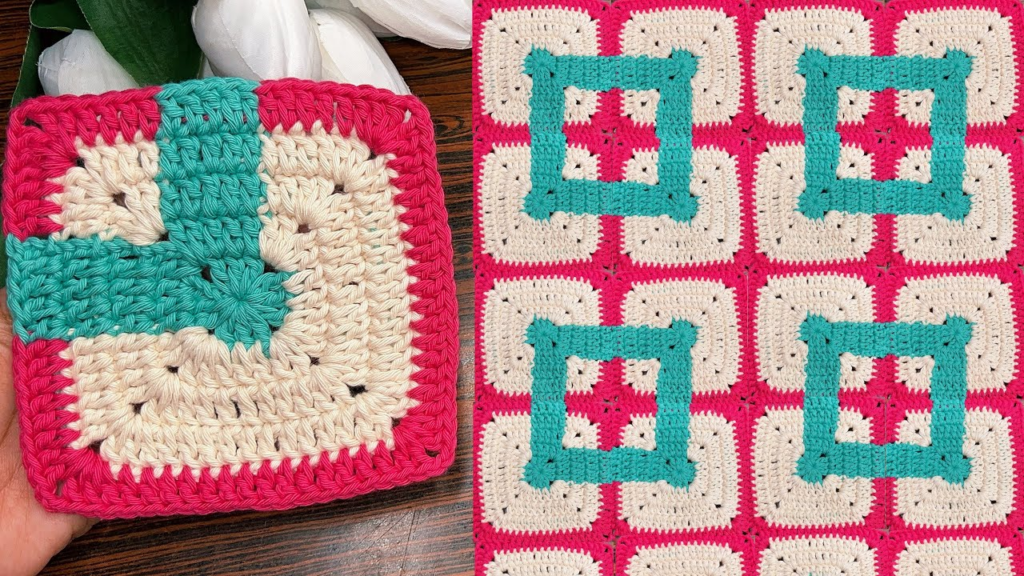
🧶 The Essential Toolkit
To make your first square, choose a “smooth” yarn. Fuzzy, dark, or multi-textured yarns make it nearly impossible to see where your hook needs to go.
| Item | Recommended | Why? |
| Yarn | Medium-weight (Worsted/Size 4) | Easy to handle and shows stitch definition. |
| Hook | 5.0 mm (H/8) | The standard “Goldilocks” size for this yarn weight. |
| Notions | Tapestry needle & Scissors | For “weaving in” the tails (the secret to a professional finish). |
🛠 Key Anatomy & Terms (US Terms)
Before we start, let’s define the “language” of the square:
- Cluster: A group of 3 double crochets (dc) worked into the same space.
- Corner Space: The hole created by 2 or 3 chains at the corners.
- Side Space: The hole created by 1 chain on the straight edges.
- sl st (Slip Stitch): Used to join the round or move your yarn without adding height.
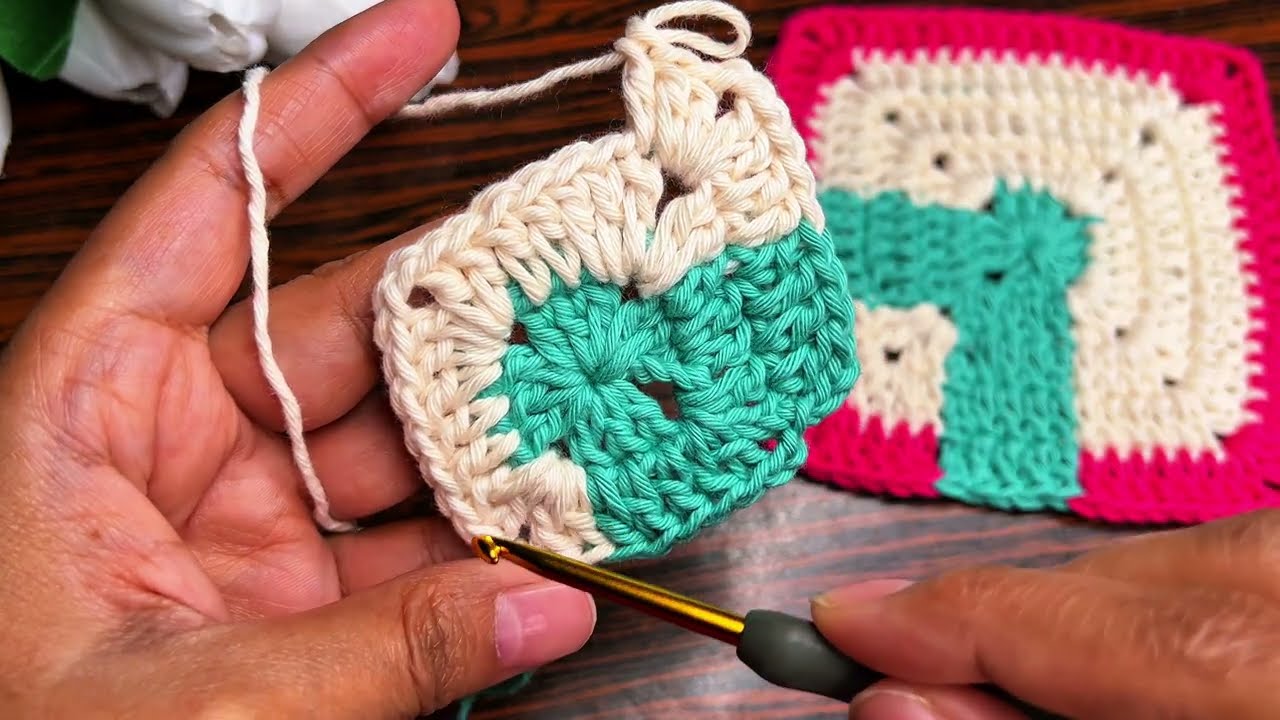
🟩 The Step-by-Step Pattern
Round 1: The Foundation
- Start: Make a Magic Ring (or ch 4 and sl st to the first ch to form a tiny circle).
- The First Cluster: ch 3 (counts as your first dc). Work 2 dc into the ring.
- The First Corner: ch 2.
- Repeat: [3 dc into the ring, ch 2] three more times.
- Join: sl st into the top of your starting ch 3.
Check: You should have a tiny square with 4 clusters and 4 corner holes.
Round 2: The Expansion
- Move to Corner: sl st into the next 2 stitches, then sl st into the corner hole.
- First Corner: ch 3 (counts as dc). In the same corner hole, work (2 dc, ch 2, 3 dc).
- Transition: ch 1.
- The Other Corners: In each of the remaining 3 corner holes, work: (3 dc, ch 2, 3 dc) followed by a ch 1.
- Join: sl st into the top of the starting ch 3.
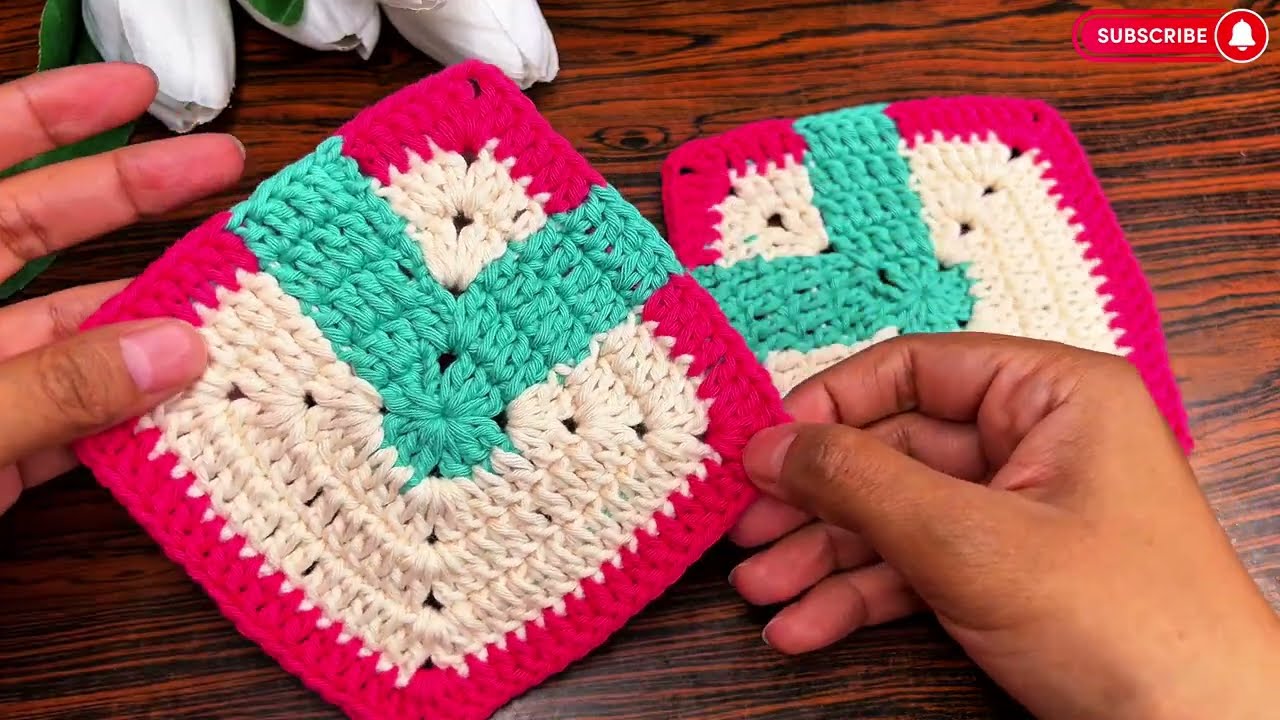
Check: Your square now has 8 clusters total (2 in each corner).
Round 3: Building the Sides
- Move to Corner: sl st over to the first corner hole.
- Corner: ch 3. Work (2 dc, ch 2, 3 dc) in the corner. ch 1.
- The Side: Look at the hole on the side between corners. Work 3 dc into that side space. ch 1.
- Repeat: Work a Corner (3 dc, ch 2, 3 dc) in every corner and 3 dc in every side space. Always put a ch 1 between clusters.
- Join: sl st to the top of the ch 3. Fasten off.
💡 Troubleshooting Like a Pro
- The “Jellyfish” Effect: If your square is curling up like a bowl, your tension is too tight. Take a breath, relax your grip, or move up to a 5.5 mm hook.
- The “Hidden Stitch”: After you finish a corner, the first stitch of the next cluster is often hidden by the corner you just made. Slide your stitches over to find the “eye” of the stitch.
- The “Twist”: Some people turn their work over after every round. This is a “Modern Twist” that keeps the square perfectly centered and prevents it from looking like it’s spiraling.
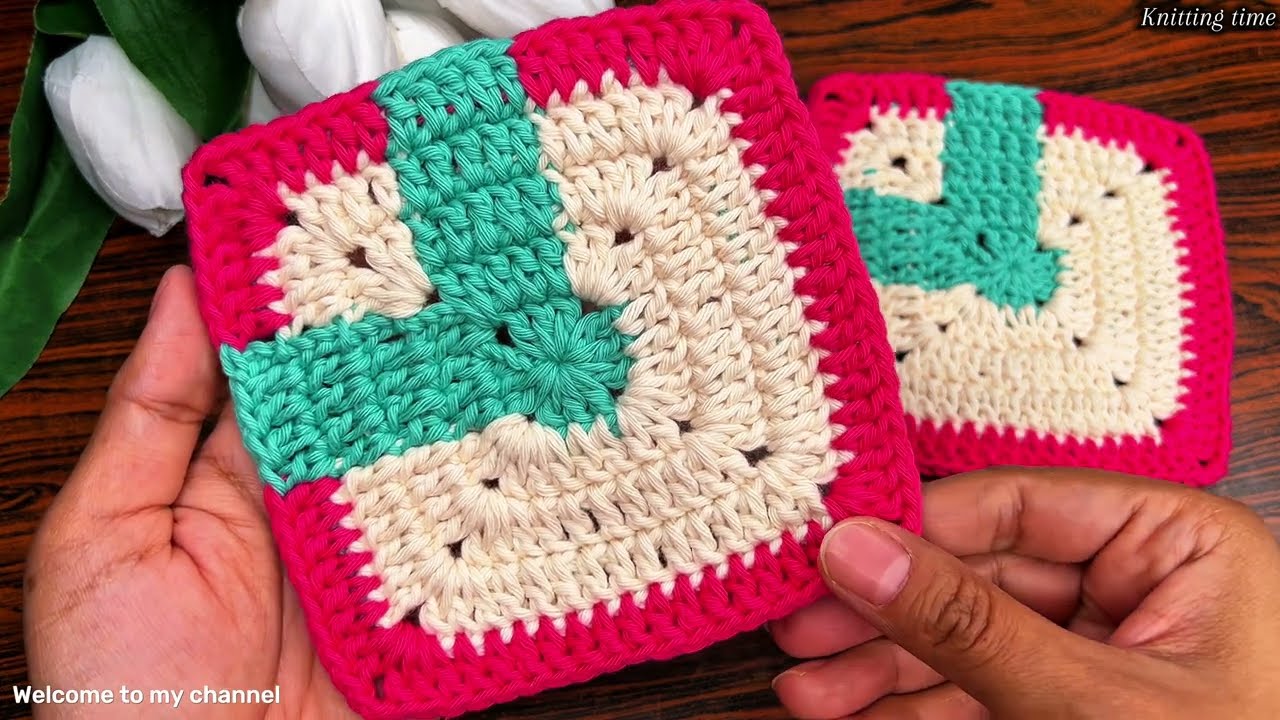
✨ Finishing the Masterpiece
- Fasten Off: Cut the yarn, leaving a 6-inch tail. Pull the loop on your hook all the way through to knot it.
- Weaving Ends: Use your tapestry needle to “thread” the tail back through the stitches. If you just cut it close to the knot, the square will eventually “commit suicide” and unravel in the wash.
- Blocking: Pin your square to a foam board in a perfect square shape and hit it with a bit of steam from an iron (don’t touch the yarn!). This transforms a “wonky” square into a professional, flat tile.
Would you like me to help you calculate how many of these squares you would need to make a standard-sized throw blanket?